Overview of types of nitride
| Ionic nitrides | Metallic nitrides | Covalent nitrides |
|---|---|---|
| ● Bonding partners are strongly electropositive metals ● Strong ionic bonds such as sodium nitride (Na3N) | ● Bonding partners are transition metals of groups 4 to 8 ● Nitrogen embedded in the metal lattice, e.g. titanium nitride (TiN) ● Very hard | ● Bonding partners are non-metals or metalloids ● Three-dimensional solids such as boron nitride ● Extremely high hardness and melting points |
INFO: Nitrides (-3N) are easily confused with nitrites (NO2−) because of the similar wording. Nitrites, however, are the salts of nitrous acid.
Types of nitride in detail & examples
Covalent nitrides
Covalent nitrides combine nitrogen with elements of main groups 3 to 5. Some covalent nitrides are also referred to as diamond-like nitrides. They consist of very strong bonds between nitrogen and non-metal atoms.
A well-known example of a diamond-like covalent nitride is boron nitride (BN). Boron nitride consists of a regular structure of alternating boron and nitrogen atoms linked by covalent bonds. This structure resembles diamond and gives boron nitride similar properties such as hardness, thermal stability and chemical resistance. Also worth mentioning is carbon nitride (C3N4), which is still being researched and could theoretically be harder than diamond.
Owing to their hardness, heat resistance and chemical resistance, covalent nitrides can be used in various industrial applications. They are used in technical ceramics, as abrasives, lubricants, high-temperature insulators and in other high-performance applications where extreme conditions prevail.
Covalent nitrides can, however, also be very reactive and unstable, as in the case of nitrogen triiodide. For example, boron nitride can be converted chemically into nitrogen triiodide: BN + 3 IF -> NI3 + BF3 (at -30 °C)
Metallic nitrides
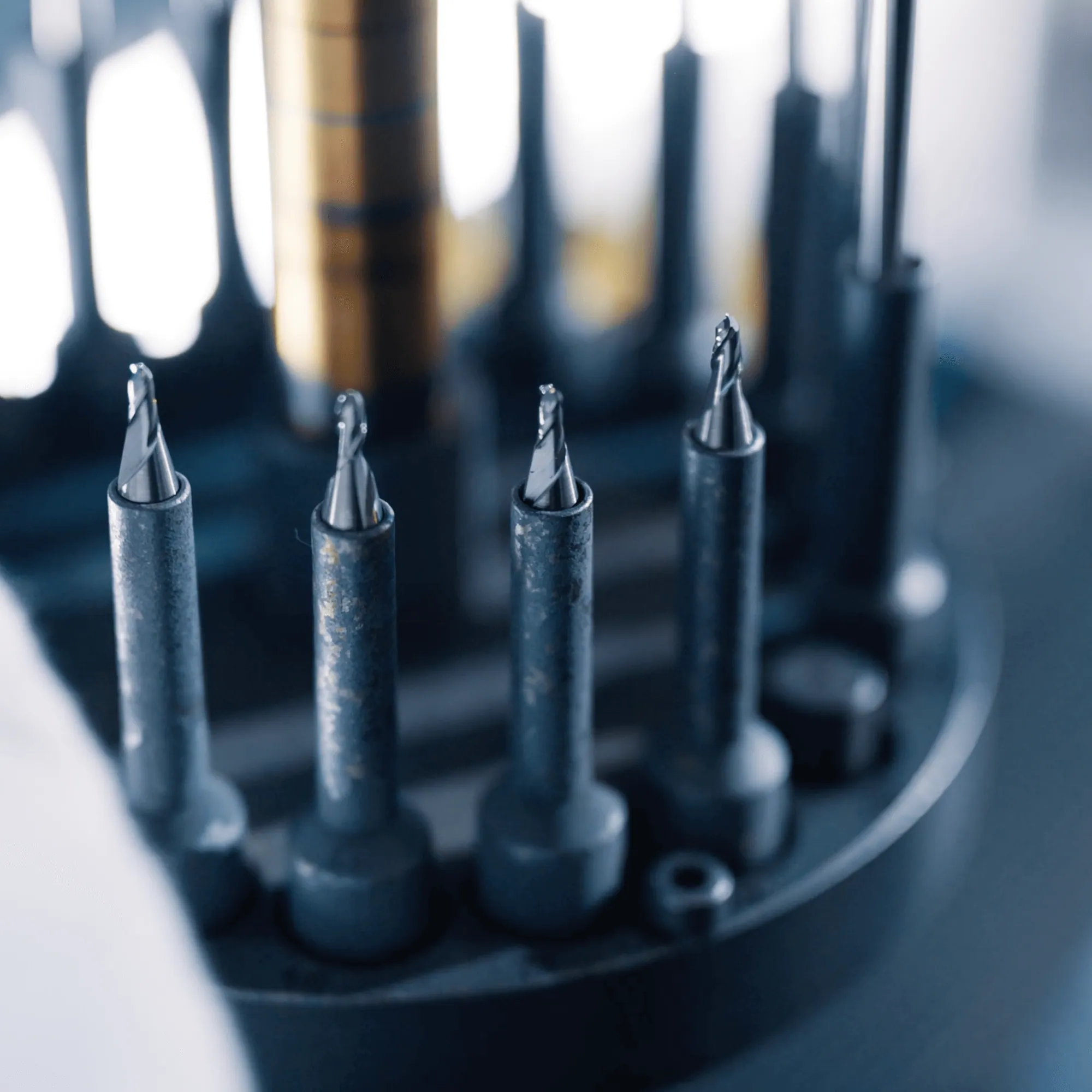
Metallic nitrides combine nitrogen with transition metals of subgroups 4 to 8. These compounds have a very hard crystal structure in which nitrogen ions are incorporated into the metal lattice (like interstitial alloys). For example, titanium nitride (TiN) is used to refine drills and chromium nitride (CrN) to refine special tools made of chromium. In addition, iron nitride phases form when steel is nitrided.
Ionic nitrides
Owing to the negative charge of nitrogen ions, ionic nitrides have very strong ionic bonds between nitrogen and electropositive metals. The structure of ionic nitrides resembles that of salts, hence the name salt-like nitrides.
In combination with water or acids, ionic nitrides undergo an acid-base reaction. Ammonia gas and metal hydroxides are formed. In this way, ammonia can be produced from magnesium, for example:
1. Combustion of magnesium powder in a nitrogen atmosphere: 3 Mg + N2 -> Mg3N2
2. Hydrolysis of the magnesium nitride with water: Mg3N2 + 6 H2O -> 3 Mg(OH)2 + 2 NH3
Further examples are alkali nitrides such as lithium nitride or alkaline-earth nitrides such as beryllium nitride, as well as other electropositive subgroup metals such as zinc nitride.
Ionic nitrides are used in various technical applications, including as catalysts, in electronics and in ceramics production. They can also serve as starting materials for the production of other compounds.
Fields of application
Nitrides are used primarily for surface hardening. Diamond-like nitrides such as titanium nitride in particular are excellently suited to high-temperature materials.
But there are many other fields of application. In electronics, for example, silicon nitride serves as an anti-reflective coating and tantalum nitride as a diffusion barrier. In addition, aluminium nitride and gallium nitride are used as III-V compound semiconductors for white LEDs.
There are many further examples.
Overview of nitrides and their applications
| Nitride | Applications | Type |
|---|---|---|
| Boron nitride (BN) | High-temperature lubricant, insulating material | Covalent |
| Aluminium nitride (AlN) | Substrate material with very good thermal conductivity for power electronics | Covalent |
| Gallium nitride (GaN) | Semiconductor material in blue light-emitting diodes | Covalent |
| Indium nitride (InN) | As indium gallium nitride for the realisation of blue, violet and green light-emitting diodes | Covalent |
| Carbon nitride (C3N4) | Subject of current research, theoretically harder than diamond | Covalent |
| Silicon nitride (Si3N4) | High-strength, high-temperature-resistant technical ceramics | Covalent |
| Germanium nitride (Ge3N4) | Nitride ceramics | Covalent |
| Tin(IV) nitride (Sn3N4) | Diffusion-inhibiting layers | Covalent |
| Phosphorus nitride (P3N5) | – | Covalent |
| Copper(I) nitride (Cu3N) | High-performance semiconductor | Covalent |
| Calcium nitride (Ca3N2) | Corrosion inhibitor in lubricants | Ionic |
| Titanium nitride (TiN) | Hardening coatings on drills, milling cutters, cemented carbide indexable inserts | Metallic |
| Tantalum nitride (TaN) | Barrier and adhesion layer in chip manufacturing and in thin-film resistors, diffusion barrier in thick-film solar cells | Metallic |
| Chromium nitride (CrN) | Treatment of special tools made of chromium | Metallic |
| Various iron nitride phases | Nitriding of steel | Metallic |
| Iron(III) nitride (FeN) | Increasing the wear resistance of steel | Metallic |
| Lithium nitride (Li3N) | Introducing nitrogen into alloys | Ionic |
| Sodium nitride (Na3N) | Preservative | Ionic |
| Beryllium nitride (Be3N2) | Refractory ceramic in nuclear reactors | Ionic |
| Magnesium nitride (Mg3N2) | Catalyst for the synthesis of borazon and light-emitting diodes | Ionic |
| Zinc nitride (Zn3N2) | Diffusion-inhibiting layers | Ionic |
| Scandium nitride (ScN) | Gate material in electronic components | Ionic |
| Yttrium nitride (YN) | Optics, ceramics, electronics | Ionic |
| Lanthanum nitride (LaN) | – | Ionic |
| Zirconium(IV) nitride (Zr3N4) | Diffusion-inhibiting layers | Ionic |
| Tantalum(V) nitride (Ta3N5) | – | Ionic |
| Uranium nitride (UN, U2N3, UN2) | – | Ionic |
Nitrides in nature
Nitrogen has a triple bond with a bond strength (dissociation enthalpy) of
946.04 kJ/mol. Oxygen, by contrast, is a diradical with a dissociation enthalpy of
498.67 kJ/mol. Nitrides can therefore form only under oxygen-free conditions, so
nitrides are very rare in the form of natural minerals. Examples are roaldite (Fe4N),
siderazot (Fe3N), osbornite (TiN), carlsbergite (CrN) and sinoite (Si2ON2).