Determining the nitriding hardness depth
The nitriding hardness depth depends on various factors, such as the duration and temperature of the nitriding process, the type of material being nitrided, and its chemical composition and surface condition. It is usually measured in micrometres or millimetres and is an important parameter for assessing the quality of the nitriding process.
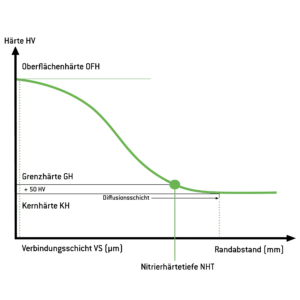
The determination of the nitriding hardness depth (NHT) is specified in the standard DIN EN ISO 18203.
It is important that the surface of the specimen has been finely machined and is suitable for measurement. The core hardness is then determined from at least three hardness indentations. This is needed to establish the so-called limit hardness, which is 50 HV above the core hardness.
A Vickers hardness test then follows, with indentations made from the edge towards the interior of the workpiece. The nitriding hardness depth is obtained by measuring the hardness profile from the surface to the calculated limit hardness (see graphic).