What does the coefficient of friction tell us?
The coefficient of friction is important for assessing the wear behaviour and sliding properties of materials. It depends on the particular material pairing and on the size and load of the objects rubbing against each other. Lubrication can also reduce the coefficient of friction. The type of friction is also decisive.
Static and sliding friction
When moving furniture, the force needed to start pushing is always higher than the force needed to keep it moving. This is due to the friction force acting between the piece of furniture and the floor. Static friction must be overcome when starting to push, and sliding friction when continuing the movement. In both cases, the coefficient of friction helps to calculate the force required.
In this example, the weight of the object also influences the coefficient of friction. The heavier the piece of furniture, the more friction force acts against the floor. This relationship is taken into account in the calculation of the coefficient of friction by the normal force.
Calculation of static friction
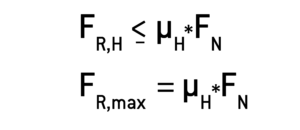
FR,H = friction force
μH = coefficient of static friction
FN = normal force
FR,max = maximum static friction needed to set the piece of furniture in motion
Calculation of sliding friction

FR,G= friction force
μG = coefficient of sliding friction
FN = normal force
Rolling friction
In rolling friction, the contact area between two objects is smaller than in sliding friction. As a result, for the same material pairing and normal force, rolling friction is always lower than sliding friction. Rolling friction is influenced by the material, the size and shape of the rolling object, and the load and speed of the movement.
A typical example is car tyres. If the engine stops, the car eventually comes to a standstill owing to
rolling friction. Another example is a ball bearing, which makes use of the low
friction between balls and rings.
Calculation of rolling friction

FR = rolling friction force
μr = coefficient of rolling friction
FN = normal force
The importance of friction in industrial applications
Friction plays a decisive role in many industrial applications. It can have positive and negative effects. Precise knowledge of the friction properties of materials and workpieces is therefore essential.
Positive effects
- Traction: In machines and vehicles, static friction improves traction
between different machine parts or between tyres and road, which ensures
better control and safety. - Power transmission: In many mechanical systems, such as gearboxes,
friction enables the transmission of motion and force from one part to
another. - Braking: Friction-based brakes are crucial for the safety of
vehicles and machines, as they enable controlled deceleration and stopping. - Material processing: Friction is used for grinding, polishing and smoothing
surfaces in order to achieve precise and smooth end products.
Negative effects
- Material wear: Friction leads to wear of machine parts,
which shortens their service life and makes frequent maintenance or replacement
necessary. - Heat generation: Excessive friction can lead to overheating of components,
which can impair their function or even cause damage. - Noise: Friction can cause considerable noise emissions, which
burden the working environment. - Oscillations: Friction can generate undesirable oscillations and vibrations
that can damage machines and structures and impair
precision.
Dealing with friction in industry
Dealing with friction in industry requires a careful balance between making use of its positive properties and minimising its negative effects.
The following strategies are used in industry to control and optimise friction:
- Lubricants: Lubricants such as oils and greases are used to lower the coefficient of friction, reduce wear and extend the service life of machine parts.
- Surface treatment: Special surface treatments such as
PVD coatings or polishing can minimise surface roughness and thus lower the coefficient of friction. - Design: Optimising the design of machines and components can reduce friction and increase efficiency. For example, plain bearings or rolling bearings reduce the friction of moving parts.
Coefficients of friction of selected materials
The following table shows the coefficient of friction of various material pairings, in each case with dry surfaces. These are approximate values, because the exact coefficient of friction is always tied to the actual conditions.
| Material pairing | Coefficient of static friction (μh) | Coefficient of sliding friction (μg) |
|---|---|---|
| Bronze on bronze | 0.18 | 0.2 |
| Bronze on grey cast iron | 0.56 | 0.21 |
| Bronze on steel | 0.19 | 0.18 |
| Grey cast iron on grey cast iron | 0.28 | |
| Steel on bronze | 0.19 | 0.18 |
| Steel on grey cast iron | 0.19 | 0.18 |
| Steel on steel | 0.15 | 0.12 |