What is notched impact strength?
Notched impact strength describes how well a material can withstand sudden impact loads without breaking. It is particularly relevant for applications in which the material is exposed to dynamic loads, such as in the automotive industry, mechanical engineering or construction.
Materials with high notched impact strength absorb the energy of the impact by deforming before they break. Their fracture surface shows a fibrous structure. Brittle materials, on the other hand, have a low notched impact strength. They break suddenly and without much deformation, and the fracture surface is smooth and flat.
Influencing factors
Various properties of the material concerned and various external factors influence notched impact strength:
- Alloy: The composition of the alloy and the microstructure, i.e. grain size and distribution, have a very strong influence on notched impact strength.
- Temperature: As the temperature falls, the notched impact strength of many materials decreases and they become more brittle.
- Component geometry: The size of the component and the wall thickness are relevant influencing factors.
- Notch geometry: The shape and depth of the notch in the specimen influence notched impact strength.
- Impact velocity: Higher velocities intensify the impact load.
Notched bar impact test
Notched impact strength can be determined by the notched bar impact test. Different methods, each with a different test set-up, are available for this. Which method is best suited to determining notched impact strength depends on aspects such as the material of the specimen and the desired test accuracy.
Charpy impact test
The notched bar impact test using a Charpy pendulum impact tester is a standardised method with the following steps:
- Preparation of a specimen: First, a rectangular specimen or test bar with a notch on one side is made. The notch must be made in the middle of the length, as a V or U.
- Carrying out the test: The specimen is clamped horizontally in the pendulum impact tester. It rests centrally on two supports. A pendulum hammer with a predefined mass then strikes the side opposite the notch in the centre.
- Energy measurement: The energy the pendulum hammer needs to break the specimen is measured.
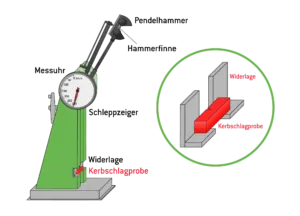
Charpy impact testing machine
Calculation of notched impact strength
The notched impact strength KCV is given in joules per square centimetre [J/cm²] and, in this test set-up, is calculated using the following formula:

E = the energy absorbed from the pendulum hammer [J]
A = the fracture area of the specimen [cm²]
Izod impact test
In the Izod notched bar impact test, a specimen with a V-shaped notch is clamped vertically in the impact testing machine so that one half is exposed from the notch upwards. The pendulum impact tester strikes the free end of the specimen.
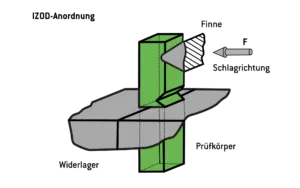
Izod impact testing machine
Dynstat impact test
In the Dynstat notched bar impact test, a test bar with a U-notch is clamped horizontally between a support and an abutment. The striker of the testing machine hits the tip of the specimen.
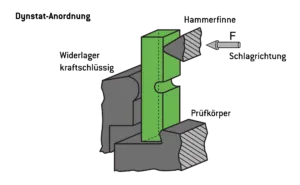
Dynstat impact testing machine
Comparison
| Feature | Charpy | Izod | Dynstat |
|---|---|---|---|
| Test bar notch | – V-shaped or U-shaped | – V-shaped | – U-shaped |
| Mounting | – horizontal | – vertical | – vertical |
| Loading | – pendulum impact at the centre of the notch | – pendulum impact on the free end | – striker on the tip of the specimen |
| Application | – Metals | – Plastics | – Weld seams – complex geometries |
| Advantages | – accurate results – simple to carry out | – simple specimen preparation | – testing of complex geometries possible |
| Disadvantages | – notch effect – notch sensitivity | – notch sensitivity – lower accuracy | – complex specimen preparation – less standardisation |
INFO
In addition to notched bar impact tests, other methods such as the tensile test or the fracture mechanics test can help to obtain more precise information on the toughness of a material.
Influence of temperature on notched impact strength
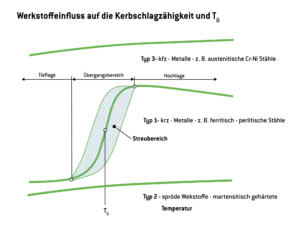
Temperature has a decisive influence on the notched impact strength of a material and thus also on the results of the notched bar impact test. As the temperature rises, toughness increases; as the temperature falls, brittleness increases. How pronounced this effect is depends on the alloy concerned.
The relationship between material, temperature and notched impact strength is illustrated in the notched impact strength curve. An important quantity on this curve is the brittle-ductile transition temperature (BDT). Below this temperature the material behaves in a brittle manner, above it in a ductile manner.
Below the BDT, a specimen in the notched bar impact test would break without plastic deformation. The BDT is decisive not only for a meaningful notched bar impact test, but also in design in a wide range of fields.