Historical background to the development of duralumin
As early as 1900, Georges Charpy developed a process for precipitation hardening. Dr Alfred Wilm successfully applied this process to aluminium alloys and invented duralumin in 1909, which the Dürener Metallwerke immediately had protected as a registered trademark.
Duralumin was a pioneering material in airship construction. It was used in 1911 in the British airship HMA No. 1 "Mayfly" and from 1914 in the German Zeppelins LZ 16 and Z XII. It made possible the development of light aircraft with all-metal fuselages, such as the Junkers F 13, and supported monocoque construction.
Material properties: advantages and disadvantages
Duralumin is a versatile material that offers a number of attractive advantages but also has disadvantages:
- Strength: The tensile strength of duralumin is between 180 and 450 N/mm². By comparison, pure aluminium offers a tensile strength of only about 80 N/mm².
- Durability: Thanks to precipitation hardening, duralumin has an extremely stable basic structure and retains its strength over a comparatively long time.
- Density: Duralumin has a density of about 2.5 up to 2.8 g/cm3. This makes its density only slightly higher than that of pure aluminium.
- Susceptibility to corrosion: In general, duralumin is more susceptible to corrosion than pure aluminium. However, corrosion resistance can be improved by measures such as anodising, aluminium cladding (Alclad) or painting.
- Weldability: Duralumin can be welded only to a limited extent.
- Formability: Duralumin can be formed well. Measures such as annealing can increase formability further.
Comparison with other materials
| Material | Density in kg/dm3 | Young's modulus in N/mm2 | Tensile strength in N/mm2 | Elongation at break in % | Brinell hardness HB |
|---|---|---|---|---|---|
| Dural AlCu4Mg1 | 2.75–2.87 | 73,000 | 420–500 | < 22 | 115–135 |
| Pure aluminium Al99.5 | 2.7 | 70,000 | 75–110 | < 7 | 22–35 |
| Unalloyed steel (S355) | 7.9 | 200,000 | 510 | 19 | 120–140 |
| Chromium-nickel steel | 7.9 | 200,000 | 500–750 | 40 | 130–190 |
| 54SiCr6 (spring steel) | 7.46 | 210,000 | 1450–1750 | 6 | 230–280 |
Applications
Thanks to its high strength and low weight, duralumin is outstandingly suitable for a wide range of industrial applications:
- Aviation: Duralumin is a key material in aircraft construction, with modern alloys such as 2017, 2117 or 2024 used in aircraft parts, wings and engines.
- Vehicle construction: Whether Land Rover, Honda, Peugeot or Austin-Healey – duralumin is used in a wide variety of applications, e.g. engine blocks, cylinder heads, gearboxes, wheels, bodywork, tanks, bumpers etc.
- Precision tools: Thanks to its high strength and good machinability, duralumin is outstandingly suitable for the manufacture of precision tools.
- Hunting and sporting firearms: Because of its robustness and lightness, duralumin is also a preferred material for bolt-action and break-action firearms.
- Construction: Duralumin is a valuable building material for lightweight structures and bridges.
- Sports equipment: Sports equipment such as bicycles and skis also benefits from the low weight and high strength of this material.
Types of duralumin
Duralumin belongs to the aluminium alloys of the AlCuMg group (material numbers 2000 to 2999). Depending on the alloy composition, properties such as strength, corrosion resistance, workability, weldability and price also differ.
The material numbers for duralumin and the applicable standards may differ regionally. In Europe we use both the EN standard (e.g. EN AW-2020) and the Aluminum Association standard (e.g. AA2020). In the USA, the AA standard is mainly used.
Based on the first digit of their material number, two main types can be classified. The following table describes some of the most important duralumin grades.
| Category | Material grade |
|---|---|
| EN AW-2XXX series | • 2024: One of the most widely used duralumin types, offering high tensile strength, excellent corrosion resistance and easy workability. • 2017: Tougher and more weldable than 2024, but with somewhat lower tensile strength. • 2020: Particularly inexpensive and easy to machine, but offers less corrosion resistance and strength. |
| EN AW-7XXX series | • 7075: The duralumin grade with the highest strength, but it is also less corrosion-resistant and more difficult to machine than other grades. • 7050: Strength is lower than 7075, but this grade is tougher and easier to weld. • 7039: Both strength and corrosion resistance are lower than 7075, but this duralumin type is particularly inexpensive and easy to process. |
Hardening of duralumin: precipitation hardening in detail
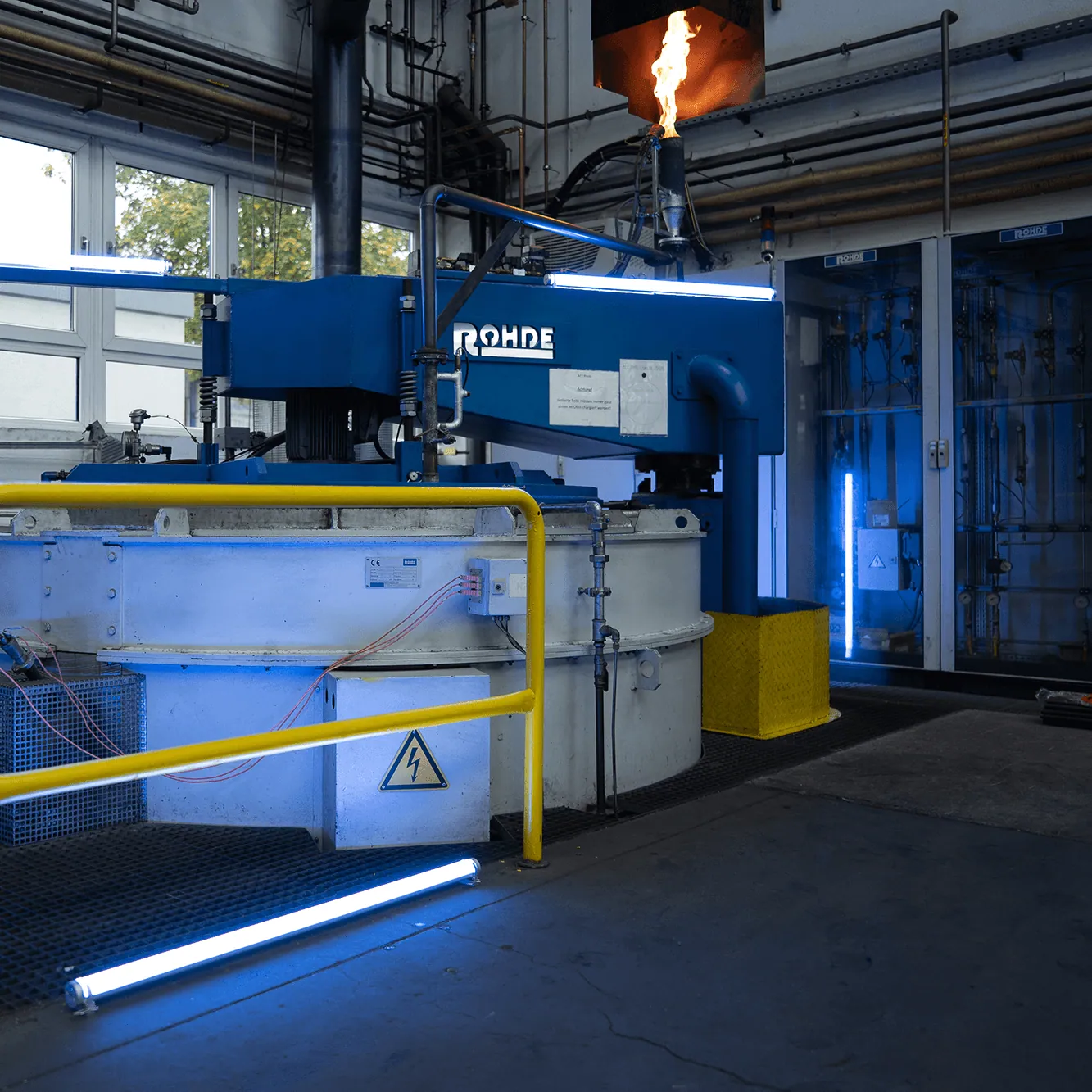
Precipitation hardening, or age hardening, is a heat treatment for increasing the strength and hardness of alloys such as duralumin. This makes the material significantly stronger than pure aluminium. The process comprises three main steps:
- Solution annealing: First, the duralumin alloy is heated to a high temperature at which alloying elements such as copper or manganese are dissolved in the aluminium.
- Quenching: The material is then cooled rapidly, often by immersion in water or oil. This produces a supersaturated solid solution, and the dissolved atoms are "frozen" in the base metal.
- Precipitation/ageing: In the last step, the material is stored at room temperature or at elevated temperature for an extended period. Fine particles (secondary phases) form from the dissolved elements. These precipitates block the movement of dislocations in the metal lattice, which increases the strength and hardness of the alloy.
The respective alloying elements and their concentration are decisive for the result of precipitation hardening:
- Copper is the basis for the precipitation hardening that gives duralumin its high strength, and it increases hardness.
- Magnesium increases tensile strength and hardness.
- Manganese ensures better elongation and tensile strength as well as higher corrosion resistance.
Recycling of duralumin: environmentally friendly resource conservation
Like other aluminium alloys, duralumin is outstandingly suitable for recycling. Reuse as secondary aluminium requires significantly less energy than primary aluminium production. Aluminium is obtained from bauxite by energy-intensive fused-salt electrolysis. The energy required to recycle aluminium, on the other hand, is only about 4 to 6 % of that of the original production process.
Recycling aluminium therefore not only saves raw materials but also reduces CO2 emissions. This makes aluminium a comparatively environmentally friendly material that contributes to sustainable materials management.