The rolling process
The exact cold rolling sequence and the individual parameters depend on the metal used and on the properties that are to be achieved. These properties are in turn closely linked to the intended use. In the automotive sector, for example, particular importance is attached to high strength and top surface quality.
Nevertheless, cold rolling can be divided fundamentally into three phases – preparation, the actual cold rolling and finishing.
Phase 1 – preparation
Thorough preparation is necessary to ensure the success of cold rolling.
This initially involves cleaning the metal of dirt and
signs of corrosion such as oxides. In addition, a heat treatment may be useful
to prepare the microstructure of the metal optimally for cold rolling.
Phase 2 – cold rolling
The actual cold rolling process mostly takes place at room temperature. Here,
the metal is pressed between two rolls. This deforms and strain-hardens the
metal and it becomes thinner. Properties such as strength also change.
Phase 3 – finishing
Once the desired thickness has been reached by cold rolling, ductility, strength and hardness can be adjusted in a targeted way by further heat treatments. Various surface treatments can also influence aesthetic aspects and increase corrosion resistance.
Cold rolling of steel and aluminium: comparison and application
Although the cold rolling process is always similar, each metal has
special characteristics that must be taken into account. In particular, the cold rolling of steel and
aluminium shows significant differences.
| Aspects | Cold rolling of steel | Cold rolling of aluminium |
|---|---|---|
| Strength and formability | ● Steel is strong and difficult to deform ● little ductility ● low elongation during deformation ● High rolling forces required to reduce thickness noticeably | ● Aluminium is soft and easy to deform ● high ductility ● thickness reduction even at low force |
| Surface quality and smoothness | ● Tendency towards surface unevenness and roughness due to work hardening of the steel ● additional surface treatment required to achieve a smooth surface | ● lower tendency to form unevenness ● better surface quality even without finishing |
| Applications and examples | ● cold-rolled steel is used where strength, stability and durability are the priority. ● Structural elements and sheets in mechanical engineering, vehicle construction and the construction industry | ● cold-rolled aluminium is used where lightness and corrosion resistance matter. ● Sheets in aerospace, cans and foils in the packaging industry |
The mechanics of cold rolling
The mechanics of cold rolling involve various parameters that must be precisely coordinated to produce the desired properties in the cold-rolled metal. The rolling force is particularly decisive.
How much force is needed to deform the metal depends on the strength of the material, the geometry of the rolls and the friction that arises during rolling. These aspects can in turn be adjusted via the roll size and the rolling speed. In this way, properties such as the thickness of the end product can be controlled in a targeted way.
Calculation of the rolling force
The formula for calculating the rolling force in cold rolling illustrates how the rolling force depends on various material parameters.
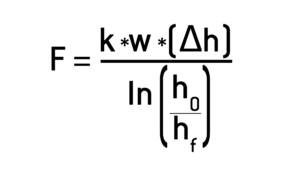
h0 = initial thickness of the material
hf = final thickness after cold rolling
k = shape-dependent strength coefficient
w = material width
Δ h = thickness reduction
Advantages and disadvantages
| Aspects | Advantages of cold rolling | Disadvantages of cold rolling |
|---|---|---|
| Mechanical properties | – targeted improvement of strength, hardness and toughness | – undesirable changes to the microstructure possible |
| Surface quality | – high surface finish with a smooth surface and low roughness | – scratches or cracks possible with inadequate preparation |
| Dimensional accuracy | – precise control of the thickness and shape of the material – high dimensional accuracy and tight tolerances | – undesirable deformation possible with complex geometries or very thin sheets |
| Efficiency | – no heating required – lower energy consumption than hot rolling | – high initial effort for preparation |
| Possible uses | – many metals suitable (steel, copper, aluminium and alloys) – versatile fields of application | – only limited thickness reduction possible |
Fields of application
Cold rolling is used in the production of components in a wide range of industries. A typical field of application is high-strength steel sheets in car body construction, which offer both safety and low weight. Cold-rolled elements are also used in electronics – for example copper foils in printed circuit board manufacturing. In addition, structural components made of cold-rolled steel are indispensable in construction.
What is the difference between hot rolling and cold rolling?
As the name suggests, the main difference between cold rolling and hot rolling is the temperature of the metal. Cold rolling can take place at room temperature. In hot rolling, the individual recrystallisation temperature of the respective material must be exceeded in order to make the material easier to form.
| Aspect | Hot rolling | Cold rolling |
|---|---|---|
| Temperature | – high temperatures – at least above the recrystallisation temperature | – room temperature or below |
| Formability | – formability increases – ductility increases | – severely limited formability – severely limited ductility |
| Surface quality | – rougher surface – finishing often required | – smoother surface – tight tolerances |
| Energy consumption | – heating of the material – higher energy consumption | – low energy consumption |
| Thickness of the end product | – can be greater | – is always smaller |
| Applications | – large structural elements – thick sheets | – thin sheets and strip – precision components |
| Choice of material | – diverse – e.g. steel, aluminium, copper | – diverse – e.g. steel, aluminium, copper |
What is a cold rolling mill?
A cold rolling mill is an industrial facility used for forming metal sheets and strip at room temperature. It typically consists of material preparation equipment, roll stands, rolling units and cooling devices.
During cold rolling, the metal is usually passed through several pairs of rolls to achieve the desired thickness and shape. Cold rolling mills are widespread in the steel and aluminium industries and play a decisive role in the production of thin, precise metal products.
History
As early as the 17th century, the first simple rolling mills in England were documented. With the Industrial Revolution, the demand for thin sheets for building machines grew. A cost-effective and efficient way of processing metals became necessary.
In the 19th century, high-capacity rolling mills and ever more advanced rolling machines were developed. The thickness of the end product could now be set precisely. This enabled use in a wide range of industries.
Another milestone in the history of cold rolling is the 20th century, with increasing modernisation and automation in the metal industry. In addition, new alloying technologies were developed, which increased the variety of metals suitable for cold rolling – and with it the range of properties of the end products.
Today, cold rolling is an indispensable process in metalworking that is used in numerous industries, from the automotive to the electronics industry.