What is cold-drawn steel?
Cold-drawn steel is stainless steel that has been cold formed by tensile forces without heating. This process is cold drawing. Wire, a bar or a pre-profile made of steel is drawn at room temperature through shaping tools in order to achieve specific mechanical properties and a precise geometry in the intermediate or finished profile.
Round bars or flat steel are easy to cold draw. Complex geometries, however, often have to be cold drawn several times. Solution annealing is a good option between the individual passes.
Steels with a low carbon content, such as C15 or C45, are particularly suitable for cold forming. These unalloyed carbon steels are generally used in applications with low mechanical loads.
Cold drawing process sequence
Cold drawing is a high-precision process that comprises three main steps:
- Preparation of the starting material: The starting material is usually a bar or wire made of stainless steel. The workpiece must be cut to the desired length. In addition, the surface must be cleaned and degreased.
- Cold drawing: For cold drawing, the workpiece is clamped into the drawing device. Under the action of tensile forces, it is then drawn at room temperature through one or more dies. The dies determine the geometry of the finished workpiece. During cold drawing, the material is lengthened and reduced in cross-section. Drawing is repeated until the desired length and thickness are reached.
- Post-treatment: After cold drawing, a heat treatment can increase the strength of the finished product, or a surface treatment can increase corrosion resistance.
Fields of application
The cold drawing of steel plays a role in many industrial sectors, for example in the automotive industry and in aerospace engineering. It is also used in electronics and in the construction industry. Specific products include tubes, springs, bolts and wire ropes.
Advantages
Cold drawing offers a wide range of advantages for a workpiece and for the production process. The most important aspect is that cold drawing can achieve very precise cross-sections. At the same time, work hardening increases the hardness of the material, and the magnetic properties can also increase. In addition, cold-drawn steel has a fine-grained, glossy surface quality. Last but not least, cost efficiency also plays a role.
Disadvantages
With very complex geometries, cold drawing is not always cost-efficient, because several passes and solution annealing as an intermediate step may be necessary. In addition, cold-rolled steel shows poorer torsional performance in bending than hot-rolled steel.
What is the difference between cold rolling and cold drawing?
Cold rolling and cold drawing are two fundamentally different processes for the cold forming of metals. The following table gives an overview of both processes.
| Cold rolling | Cold drawing | |
|---|---|---|
| Starting material | – Plate, strip or wire made of metal | – Bar or wire made of metal |
| Process | – Workpiece is passed through two or more rolls | – Workpiece is drawn through one or more dies |
| Main objectives | – Reduction of thickness – Smoothing of the surface | – Reduction of diameter – Lengthening – Shaping |
| End product | – flat or strip-shaped – sheets, strip | – various geometries – wire, bars, tubes |
| Application | – e.g. automotive engineering, construction, electronics | – e.g. automotive engineering, aerospace, mechanical engineering |
Can cold-rolled steel be welded?
Cold-rolled steel can be welded under certain conditions. These include precise surface preparation and a suitable welding process. Preheating the steel can also improve the quality of the welded joints.
Suitable heat treatments after cold drawing
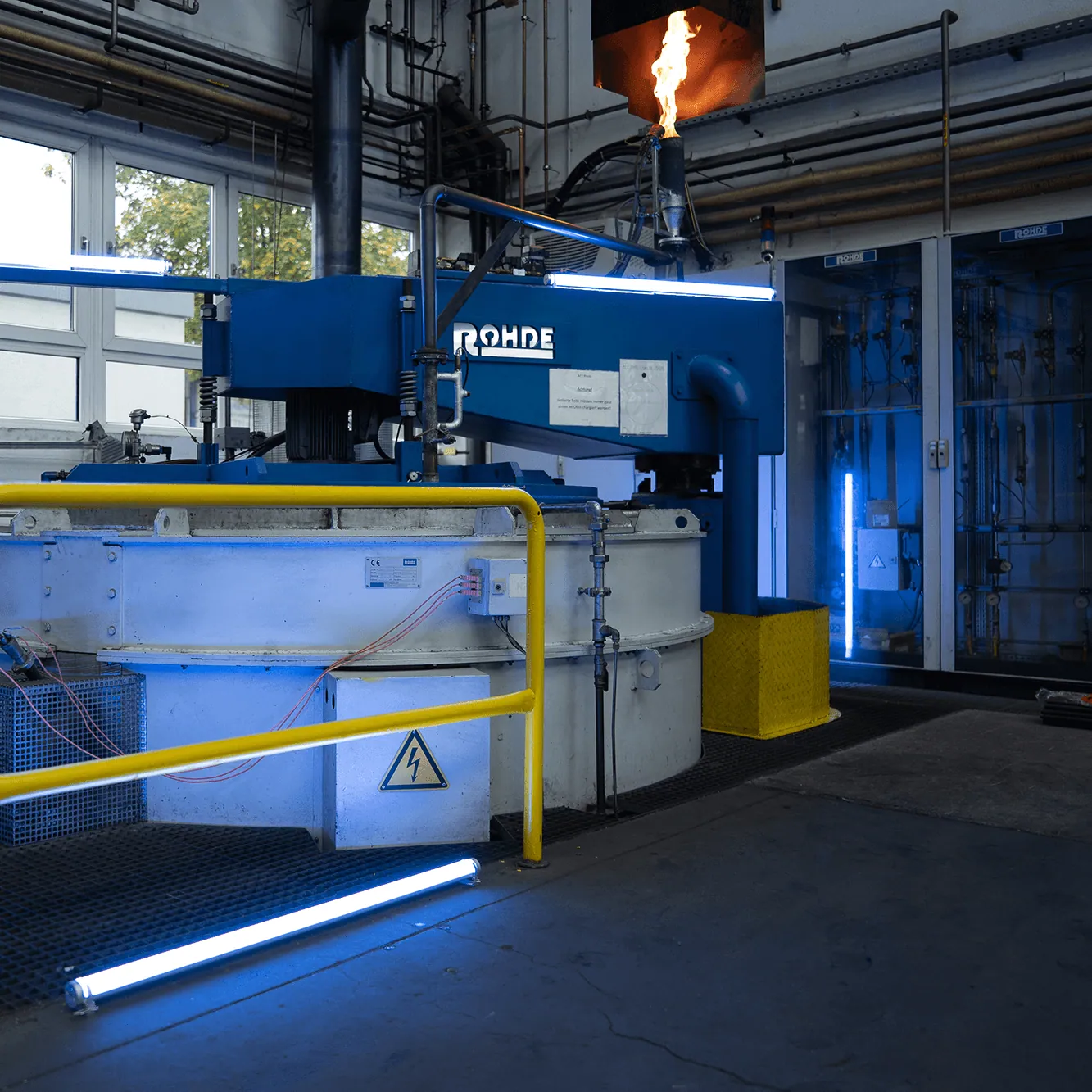
After cold drawing, various processes are available to further improve and tailor the mechanical properties of the end product:
- Tempering: Tempering is suitable for relieving internal stresses that arose during cold drawing. For this, the material is first heated and then cooled slowly. This reduces hardness and increases toughness.
- Quenching and tempering: By quenching and tempering, high-strength steels achieve higher strength and hardness after cold drawing. For this, the steel is heated to a high temperature and then cooled rapidly. The result is a martensitic structure.
- Solution annealing: In solution annealing, the material is heated to eliminate impurities and crystal defects. The aim is to homogenise the grain structure for better toughness and ductility. Solution annealing is used primarily for stainless steels.
- Normalising: Normalising can relieve internal stresses and refine the grain structure. For this, the material is heated moderately and cooled slowly.