Process
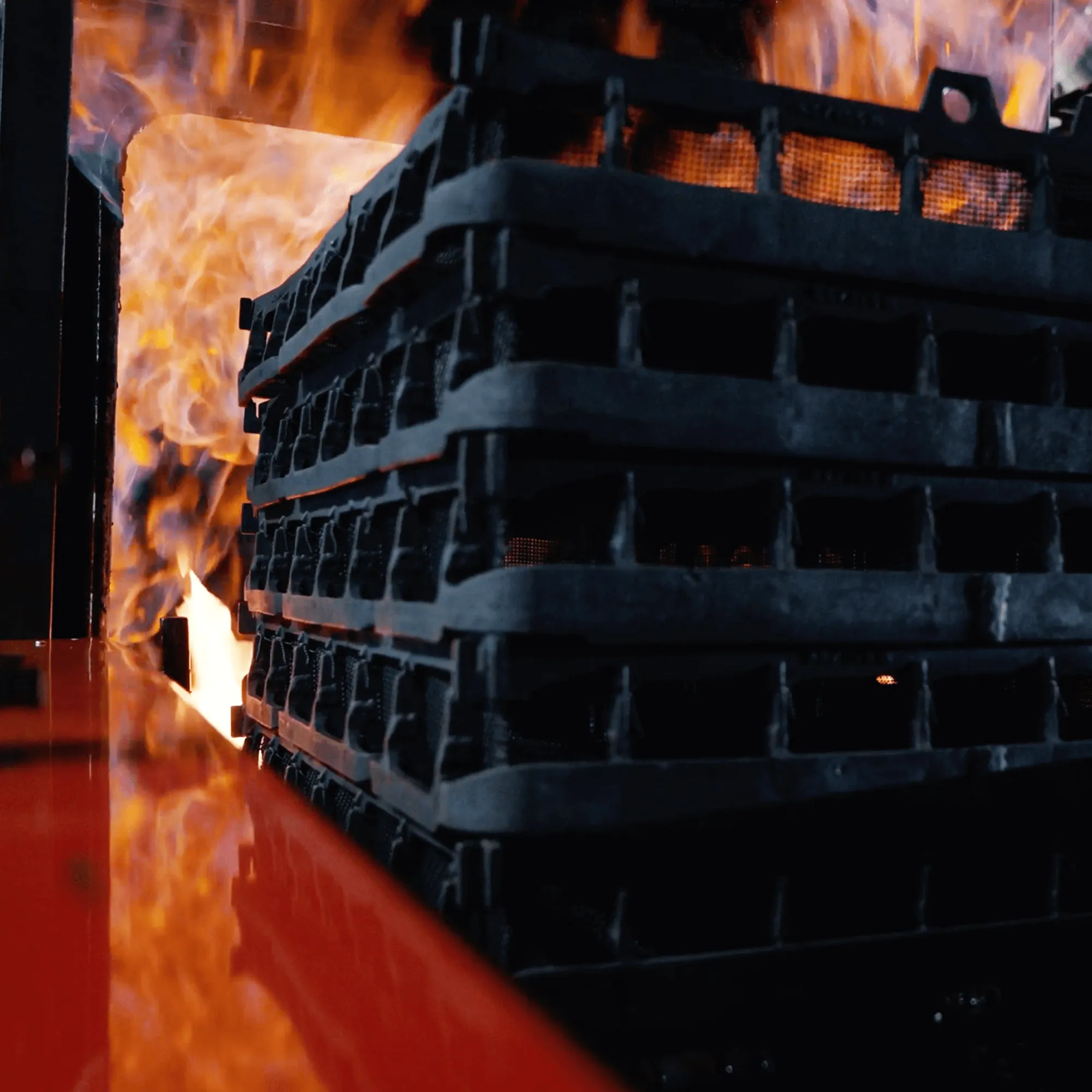
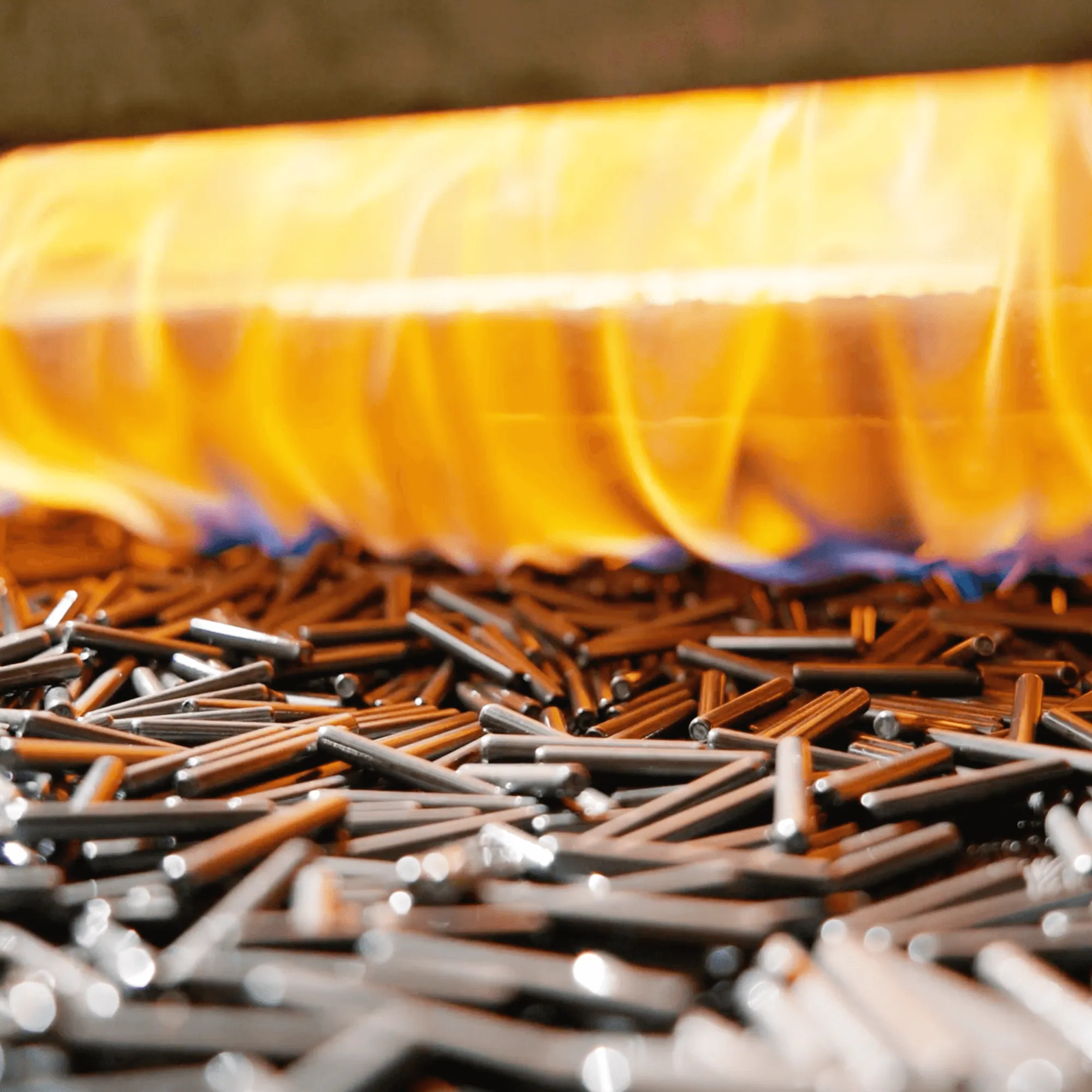
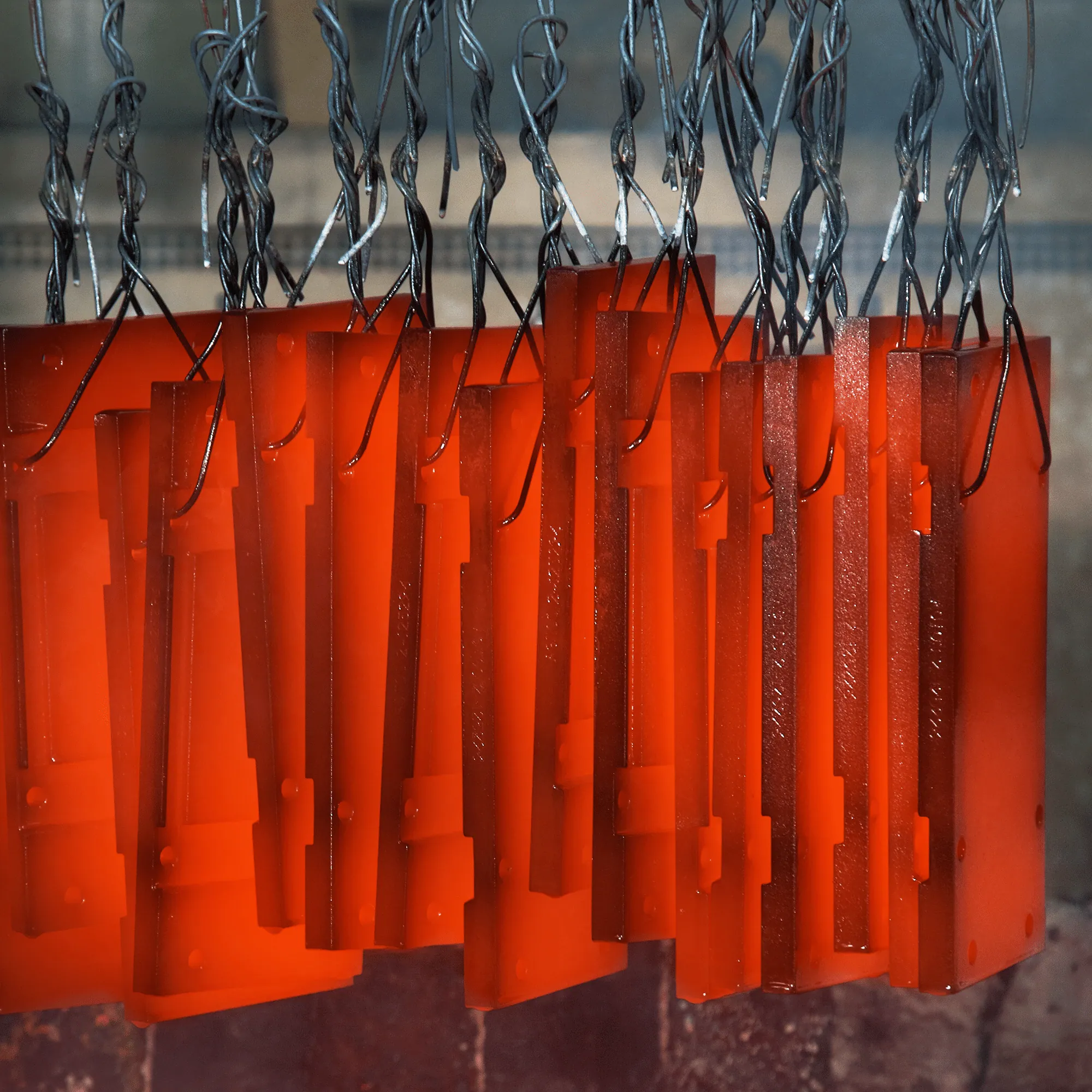
In through hardening, the workpiece goes through the same steps as in hardening – heating, holding and quenching. Heating the steel to austenitising temperature distributes the carbon atoms throughout the structure. The holding time ensures that this process takes place throughout the material and a homogeneous structure forms. During quenching in water, oil, air (gas) or in a molten salt, austenite is transformed into bainite or martensite. The focus of through hardening is a uniform structure from the edge of the workpiece to the core. This is also referred to as full hardening.
The individual hardening temperature for through hardening depends on the steel grade concerned. It is between 800 °C and 1,220 °C. Austenitisation starts at 730 °C to 900 °C, depending on the steel grade. Workpieces with a small cross-section (up to about 10 mm) through-harden automatically. For components with a larger cross-section, the achievable hardening depends on the wall thickness and the steel grade. Parameters such as the hardening temperature and the holding time can also influence the target hardness.
Advantages
Through hardening can give a workpiece a number of attractive advantages. The main benefits are:
• Higher hardness
• Increased strength
• Better wear resistance, depending on the steel grade
• Better mechanical resistance overall
Application
How well a steel is suited to through hardening depends on its composition.
The carbon content in particular determines the attainable hardness. Alloying elements such as chromium, nickel or molybdenum influence the quenching rate and hardness penetration.
Steels that through-harden well are medium- and high-alloy steels.
Examples of steels that are well suited to through hardening:
| Steel no. | Designation |
| 1.2343 | X37CrMoV5-1 |
| 1.2767 | 45NiCrMo16 |
| 1.2714 | 55NiCrMoV7 |
| 1.7225 | 42CrMo4 |
| 1.2842 | 90MnCrV8 |
Suitable hardening processes
We offer the following hardening processes for through hardening:
You can find more detailed information on the respective process pages.
What mistakes can be made during hardening?
The hardening and through hardening of steel must be carried out by experienced specialists in order to avoid errors. Typical sources of error are:
- Wrong choice of material: Too few alloying elements, too low a carbon content and unsuitable steel grades can lead to uneven hardness distribution or low hardness.
- Insufficient hardening temperature: If the austenitising temperature is not held for long enough, this can lead to uneven carbon distribution and insufficient dissolution of carbon in the lattice, and cementite remains in the structure.
- Holding time too long: Too long a holding time or too high a hardening temperature can cause retained austenite and soft spots. It can also lead to coarse-grain formation and thus have a negative effect on the toughness of the component.
- Heating or quenching too quickly: If the material is heated or quenched too quickly, stress cracks and hardening cracks can occur.
- Unwanted decarburisation in the surface layer: If the steel is held at high temperatures in an environment with a low carbon content, this can lead to a reduction in the carbon content in the outer layer.