Single hardening
Single hardening is a hardening process in which the steel is reheated after carburising. The aim of this approach is grain refinement. This makes this variant of case hardening particularly suitable for steels that tend to form coarse grain during carburising. Single hardening is also used where intermediate machining is necessary.
The desired grain refinement is achieved through recrystallisation based on γ-α transformations. For this, the steel must first be cooled slowly after carburising and reheated in a separate step.
Single hardening for case hardening
Single hardening is suitable for case hardening. Since the edge zone of the workpiece is richer in carbon than the core after carburising, relatively low temperatures (750 °C to 850 °C) are sufficient for complete austenitisation of the case structure. This is known as the case hardening temperature. In the core region, which is lower in carbon, austenitisation is then not complete. After quenching, a fully martensitic structure therefore forms only in the case region. Residual ferrite can remain in the core region. Single hardening is thus particularly suitable for setting specific surface properties of a workpiece.
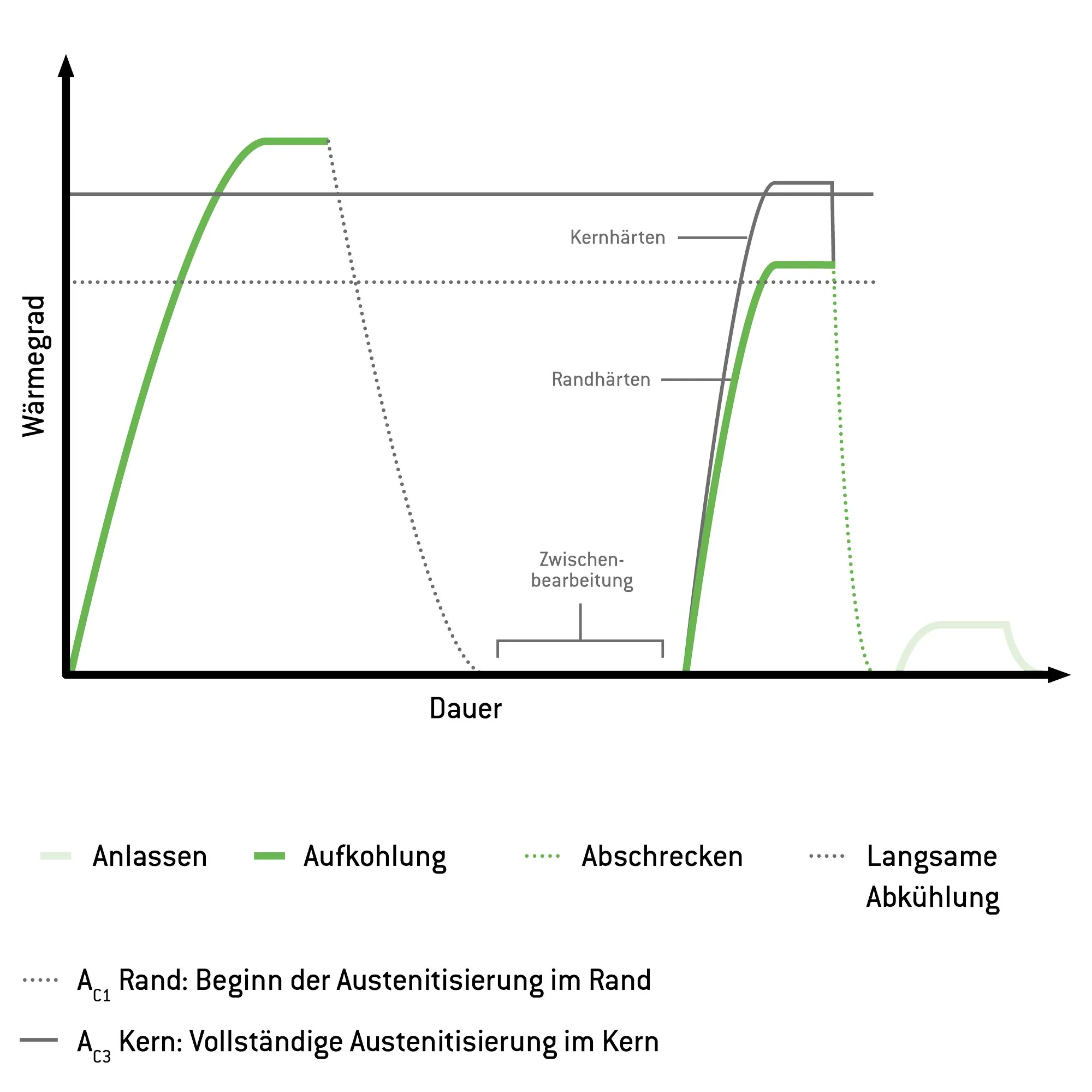
Time-temperature diagram of single hardening
Single hardening for core hardening
At a corresponding core hardening temperature, single hardening can also be used for targeted core hardening. To achieve complete austenitisation of the core, high temperatures of around 900 °C are necessary. After quenching, this can lead to a coarse acicular case structure. A combination of case and core hardening is also possible – known as double hardening.
Double hardening
Double hardening describes various variants of a double heat treatment. For example, two successive hardening processes are referred to as double hardening, or annealing followed by hardening. As a rule, double hardening is carried out at a constant temperature. This allows the grain size of the workpiece to be refined after the first long austenitising or a long carburising process. At the same time, the case hardening depth is increased.
Another meaning of double hardening refers to hardening twice after carburising. The first hardening takes place at the core hardening temperature and the second at the hardening temperature of the case layer in accordance with DIN 17014.
Double hardening can also include longer austenitising or a longer carburising process with slow hardening or cooling outside the heating chamber. This is similar to the annealing process. Hardening is then repeated by re-austenitising and quenching.
Process sequence
Double hardening as a combination of case and core hardening is one way of setting the desired core and case properties of a workpiece. For this, after carburising the workpiece is cooled to the core hardening temperature and then quenched. In this way, the desired core properties can be set. The workpiece is then brought to the case hardening temperature again in order to optimise the properties of the case. However, with this method a lot of distortion is to be expected because of the repeated temperature changes.
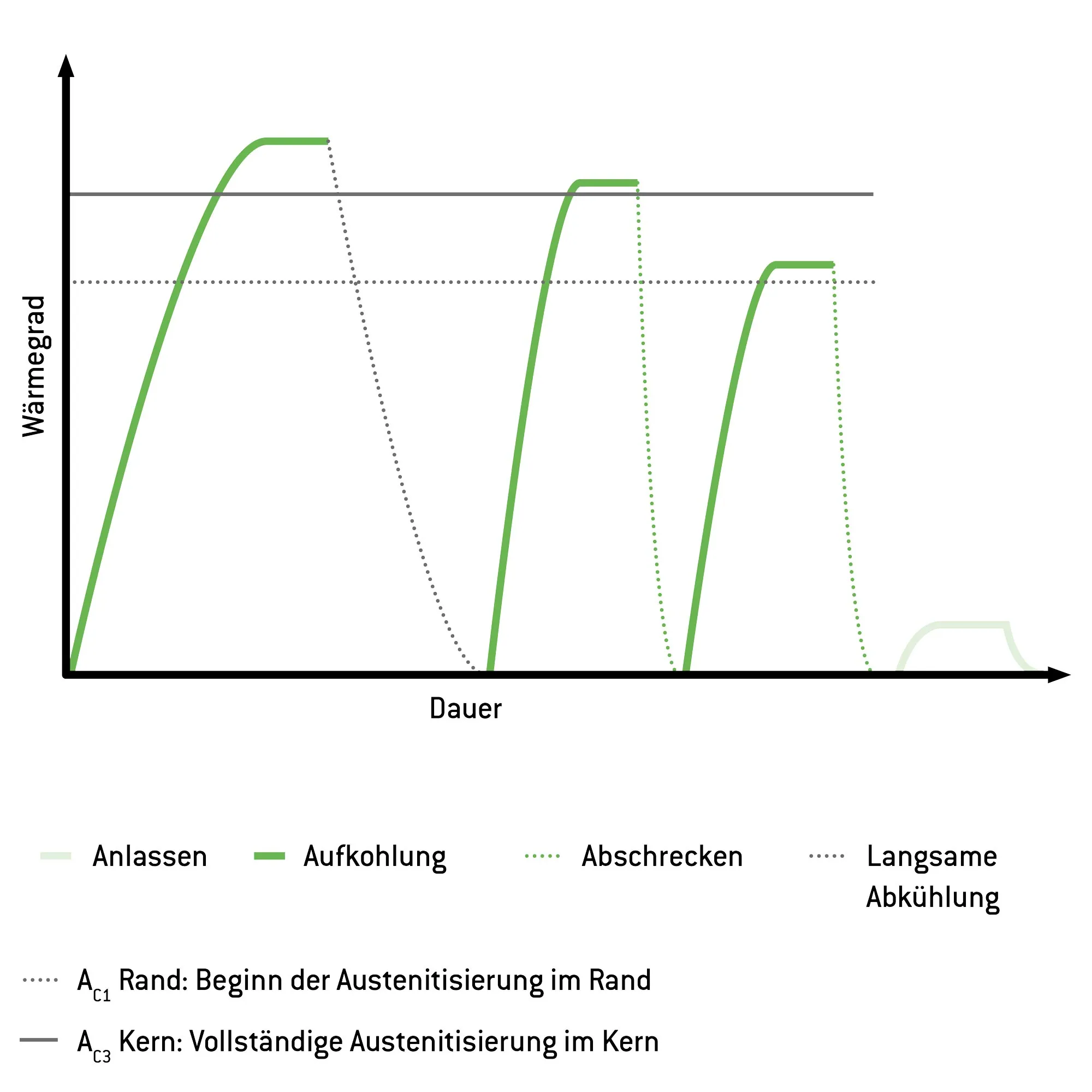
Time-temperature diagram of double hardening
Fields of application for single and double hardening
Single hardening and double hardening cost relatively a lot of time and energy because of the repeated heating processes. These processes are therefore mainly used for steels that tend to form coarse grain. For steels that are less likely to form coarse grain, such as chromium-molybdenum steels, these processes are considered uneconomical.
Single hardening is used to increase the wear resistance of a wide variety of components . Double hardening is of particular interest for components that must have a deep case hardening layer.
| Single hardening | Double hardening |
|
|
Supplementing with other processes
Intermediate annealing can be combined well with single hardening and double hardening. The aim is to minimise the formation of retained austenite during grain refinement. Intermediate annealing can also reduce distortion. For this, the workpiece is annealed with a long holding time below the transformation point Ac1.