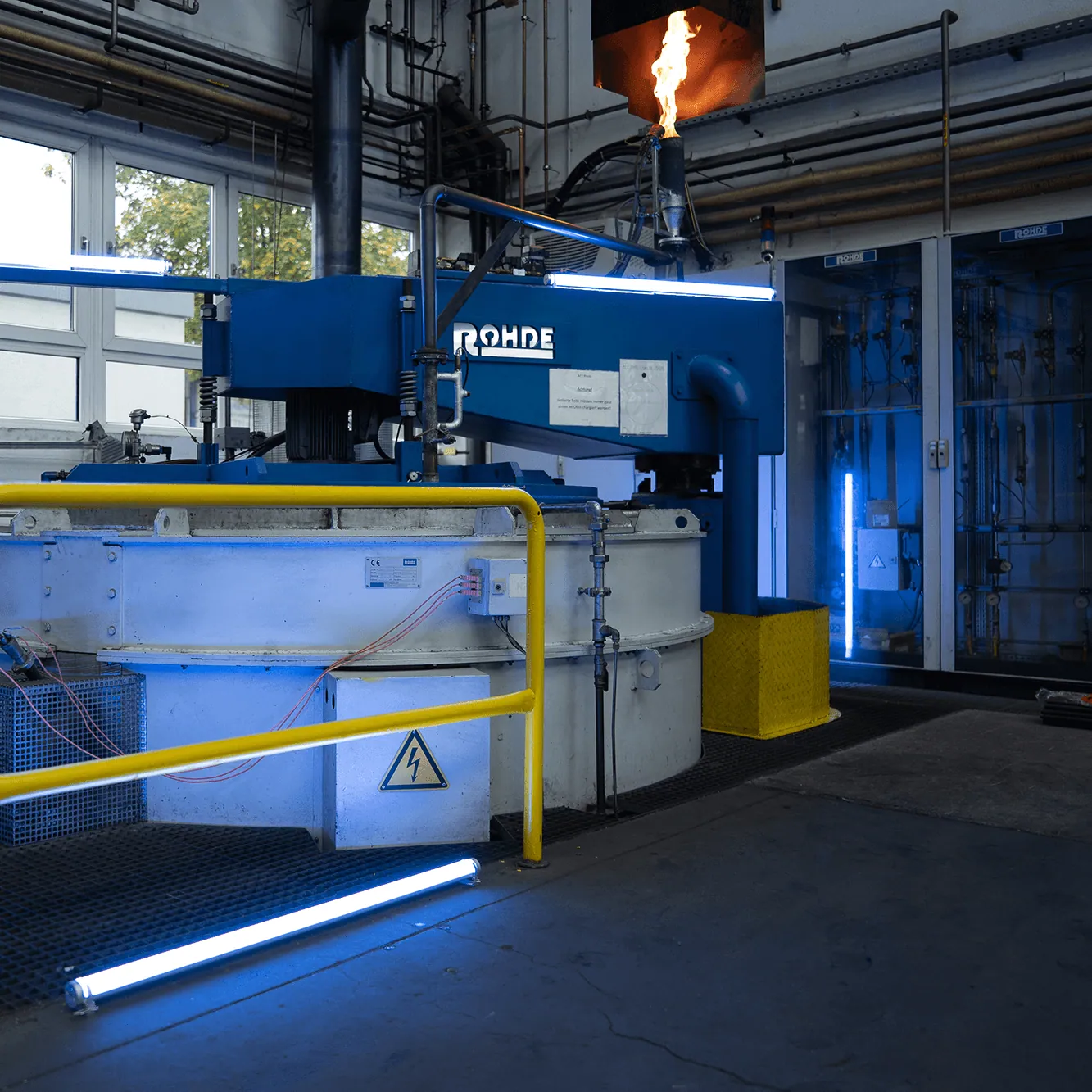
Segregation explained simply: Segregation in steel is comparable to the annual rings of trees, which arise from different cell growth over the course of the year. Similar to annual rings, segregation is due to inconsistencies in the mixing process. It can occur singly or repeatedly in the microstructure.
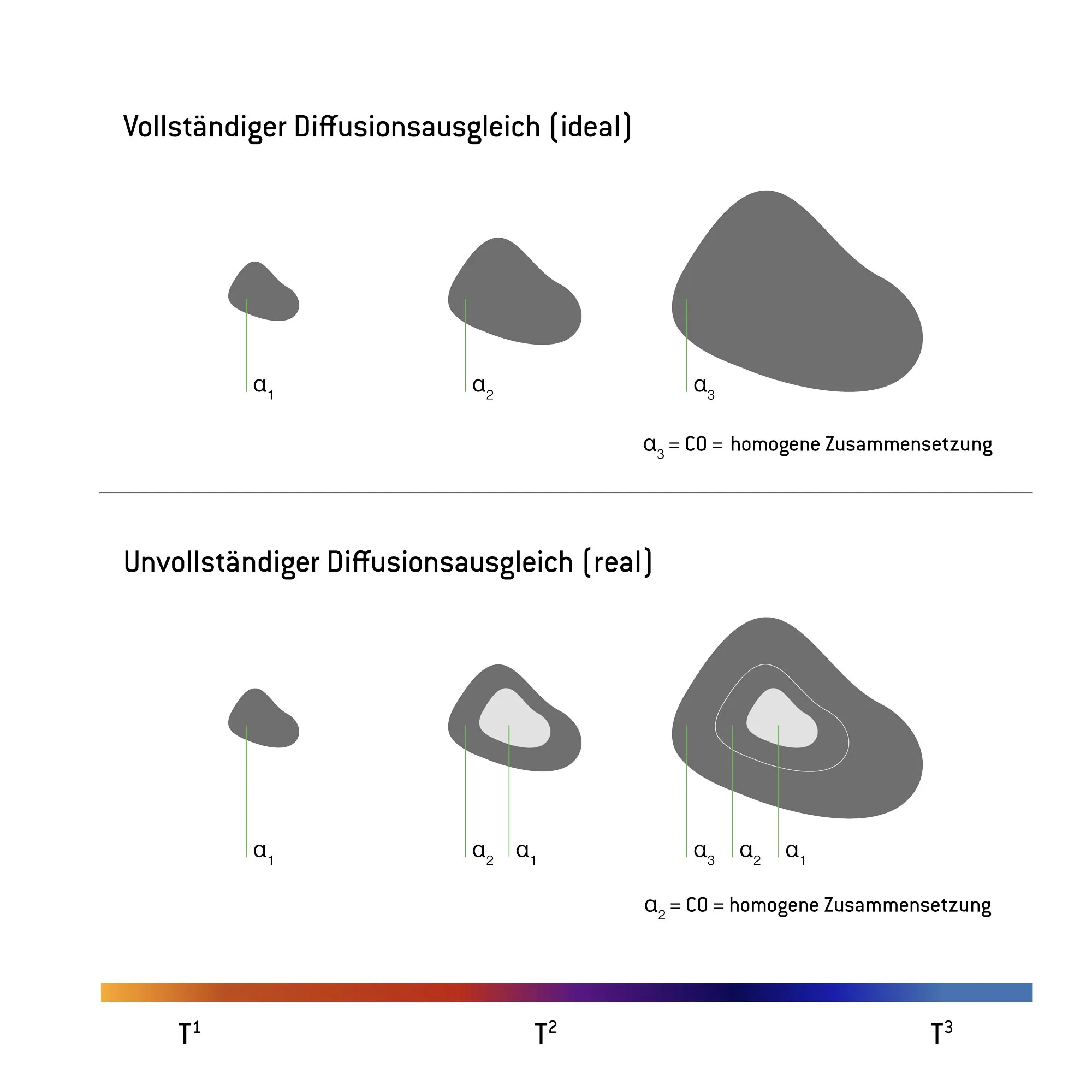
Difference between complete and incomplete diffusion
Microsegregation
Microsegregations are small, finely distributed irregularities or concentration differences at crystal level. They are generally visible at microscopic level and extend over relatively small areas of the material. Microsegregations can arise, for example, from local differences in solidification or from the diffusion of alloying elements.
Macrosegregation
Macrosegregations are larger, coarser or more visible irregularities or concentration differences. They are visible at macroscopic level and extend over larger areas of the material. Macrosegregations can arise, for example, from improper mixing of components or uneven distribution of alloying elements.
Block segregation
Block segregations manifest themselves in the form of separate blocks or regions within a material. They occur mainly in continuously cast products, ingots and castings made of aluminium and copper alloys. They also arise during solidification or through mechanical deformation, such as rolling or forging. In contrast to more finely distributed micro- or macrosegregations, which can extend continuously through the material, block segregations occur in clearly delimited areas.
Inverse block segregation: Normally, workpieces solidify from the outside inwards and the segregations form predominantly in the centre of the workpiece, which solidifies last. In inverse block segregation, the impurities accumulate at the edge of the workpiece. This happens when the residual melt is forced to the outside by the solidification pressure or by a suction effect of the capillaries between the solidified crystals.
Gravity segregation
Gravity segregation occurs owing to the different densities of the alloying elements. It is observed mainly in alloys containing tungsten or lead. If the casting mould rotates while the melt solidifies, gravity segregation can be prevented.
How does segregation affect material properties?
Segregation can significantly affect the properties and performance of a workpiece. Local inclusions, hardness variations and microstructural anomalies can lead to reduced strength and toughness, distortion, embrittlement and even cracking. This affects the usability and workability of the workpieces concerned. Segregation sometimes also affects the visual appearance of a material. It can appear as unwanted patterns or spots and impair surface quality.
Preventing segregation
Segregation must be avoided or minimised in order to ensure the functionality of the workpiece. To do so, the anomalies must first be examined. This is generally done with special measuring instruments such as a scanning electron microscope or a microprobe.
Diffusion annealing is a suitable measure for minimising existing segregation. However, this process is only suitable at micro and macro level and not for block segregation.
To prevent segregation from occurring in the first place, the melting process must be carried out professionally and monitored closely. To avoid block segregation, degassing the melt by an oxidising pretreatment is advisable. In addition, the permitted casting temperatures must be observed and overheating prevented. The holding time should also be no longer than necessary.
To prevent microsegregation, the suitability of the material must first be tested. This includes testing the accompanying and trace elements, the sulphur and phosphorus content, etc. Mould or stream inoculation ensures a finer distribution of the nodular graphite in the material and an even distribution of silicon right up to the grain boundaries. In addition, oxygen uptake from moist materials should be avoided, and a cooling rate that is as uniform as possible is important.