Definition and schematic representation
At the atomic level, ductility describes the deformation of the crystal structure under the action of force. Forces in the normal direction cause the lattice planes (or monolayers) of a material to shear off. The material effectively flows apart.
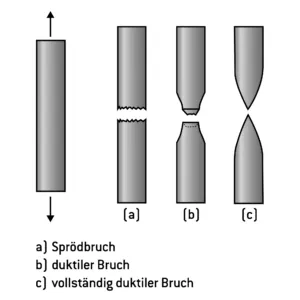
The opposite is brittleness, which makes materials quickly fracture under load. In brittle materials, the lattice planes separate easily from each other without any change in the crystal structure. Brittle fracture occurs.
Ductility is best illustrated by different types of fracture – see figure.
External factors influencing ductility
External conditions have a major influence on the ductility of a material. This applies above all to the speed of loading during operation. Temperature can also be decisive.
For example, unalloyed and low-alloy steels, or chromium and molybdenum, have sufficiently high ductility at high temperatures but become brittle at low temperatures. Austenitic steels, copper and nickel, on the other hand, offer high ductility at both low and high temperatures.
These aspects must be taken into account in the design, otherwise extreme temperatures or load peaks can quickly have serious consequences – especially in structures or vehicles.
Types of material by ductility
Three main types of material can be distinguished by their ductility.
The decisive factor is the degree of deformability up to the elongation at break A.
| Brittle materials A ≤ 0.1 % | Ductile materials A ≈ 10 % | Superplastic materials A ≈ 1000 % |
|
|---|---|---|---|
| Behaviour under load | Brittle materials offer high hardness and fracture strength, but low toughness. If fracture occurs, it happens without warning, because the material does not stretch beforehand. | Ductile materials withstand high loads and deform before they fail or fracture occurs. | Superplastic materials can be deformed very strongly under low loads. During shaping, the crystal structure changes. This makes very complex shapes possible. |
| Examples | Cast iron alloys | Alloys and metals such as copper, aluminium, steel | Special fine-grain alloys |
| Applications | Specific fields of use where high hardness is required – for example in mechanical engineering. | Wide use in the construction, electrical and automotive industries. | For high-precision manufacturing processes in aerospace and medical technology. |
Reinforcing steel and reinforced concrete
Steel has a positive effect on the ductility of concrete. For this reason, reinforced concrete is used in many structures. Reinforced concrete is a composite material of concrete and reinforcing steel. Both components are bonded on the construction site using cement. Reinforcing steel is available in various ductility classes.
| Ductility class A | Ductility class B | Ductility class C | |
|---|---|---|---|
| Properties | normally ductile | highly ductile | very highly ductile (earthquake steel) |
| Examples | Reinforcing steel mesh, reinforcing steel in coils, cold-ribbed, lattice girders, reinforcing wire, plain and profiled | Reinforcing steel bars, reinforcing steel in coils, hot-rolled | Reinforcing steel bars, reinforcing steel in coils, hot-rolled |
Example: electrical terminal connections
Ductility can also become a problem – for example with solder used to connect electrical terminals. If pressure is built up by a screw connection, the ductile solder gives way over time. As a result, the connection becomes loose and the resistance at the terminal increases.
In the worst case, this can lead to a cable fire at high currents because the insulation melts. To prevent this problem, wire end ferrules can be used instead to stabilise the stranded conductors and the terminal connection.
How is ductility measured?
The degree of ductility is decisive in determining suitability for certain applications. In metalworking, ductility can be measured by a tensile test on a tensile testing machine. For this, a sample of the material is subjected to increasing tensile force. The elongation reached by the sample before it breaks is then measured.